1. I am now selling a number of video games and systems on eBay. Click here if you're interested in some of my old Nintendo products. Sorry for the additional self-promotion; this will be the last for a long while.
2. I am considering using this blog to host a giveaway of a number of horror fiction books I've collected over the years but no longer want. Most of them are from Cemetery Dance Publications; authors include Al Sarrantonio, Kealan Patrick Burke, Rain Graves, Ray Garton, Jack Ketchum, Richard Laymon, and others. If you would be interested in such a giveaway, please comment, so I can gauge interest.
3. I apologize for the lack of actual content over the past week. After a book-heavy February, I've been busy with one thing and another and not doing much reading. Coming soon, but not all that soon, are a Noonday Sun post on Fritz Leiber's Fafhrd and the Gray Mouser stories, and a gushing appreciation of Tanith Lee's short fiction.
Wednesday, March 9, 2011


Wednesday, March 2, 2011
Kyle Murchison Booth
"What do your friends call you?"I am, it seems, incapable of judging many writers well on first reading. For every author I've loved from word one, there's someone whose work I at first thought was flawed, or (worse still) barely noticed at all. So it was with Sarah Monette. Sometime in late 2007 I was at a used book store in Providence, Rhode Island, and on the shelf was a copy of The Year's Best Fantasy and Horror for 2006. (Too recent to be on most used book store shelves, but I think this was a review copy that had been dropped off there.) It looked like new and was marked down from $21.95 to $7.50, so even though I had mixed feelings about the series I decided to buy it.
I bit back the instinctive honesty of, I have no friends, and said, "Booth, mostly."
-"The Venebretti Necklace"
That was something of a fateful decision, as most of my current horror library has grown, directly or indirectly, out of that purchase. And the number of authors I now admire who I first encountered within those pages is substantial: Christopher Harman, Stephen Gallagher, Margo Lanagan, Nicholas Royle, Kaaron Warren, Terry Dowling, M. Rickert, Stephen Volk, Stephen Graham Jones, Glen Hirshberg. And, of course, Sarah Monette.
One of the horror selections in that book was "Drowning Palmer," about an introverted museum archivist whose unwilling attendance at a school reunion leads to a disturbing dream and a shocking discovery. On first reading, I must confess, I had the same reaction to it that I often had to stories in YBF&H: it was well-crafted but not especially compelling or frightening. But something about it must have satisfied me, because a few months later, during spring break, I found a copy of Monette's collection The Bone Key on the new books shelf at my library, and I decided to give it a whirl.
If you really want to see the god-awful paragraph long review I wrote back then, you can click here. Even then, I didn't appreciate these stories as much as they deserved. But before I witter on about me a little more, perhaps I ought to say something about the actual stories.
* * *
Who is Kyle Murchison Booth? If you want a very short answer, the epigraph to this essay isn't a bad choice. But for the more detail-oriented: Booth is an archivist at the Samuel Mather Parrington Museum, in an unspecified American city, sometime in the early 20th century. He's in his mid-thirties, over six feet tall, and his hair is entirely white. He finds even basic social situations and interactions awkward. And he has far more than his share of encounters with ghosts, demons, and other supernatural creatures.
Or, to give the answer from outside the fiction, here's Sarah Monette herself, in the introduction to The Bone Key:
But then Booth, solitary by nature, has nothing much to say to anyone. After the death of his parents when he was twelve, he was raised by his father's business partner, a cruel man with a cruel wife who treated him as a waste of air and organs. As an adult, he works, and sleeps when he can, and maintains cordial but distant relations with his co-workers, who respect his intellectual gifts but often don't know what to make of him. He is, in other words, the sort of person a Lovecraftian or Jamesian protagonist might be, if they were fully-conceived characters rather than narrative markers. (I don't mean that as a criticism of HPL or MRJ.)
Booth's narrative voice is likewise reminiscent of James and Lovecraft, though it lacks the light satirical touch of the former and the ponderous vocabulary of the latter. He describes events and feeling directly, in a style that is formal but not florid, capable of dry humor (I treasure the portrait of the museum staff in "The Venebretti Necklace"), and easily readable in a way that too many homages to those writers are not. Here's the opening to "Drowning Palmer:"
Why, then, did I not appreciate this story when I first read it? Well, for one thing, I was 21, and still a beginner at recognizing and appreciating skillful, subtle horror fiction. I was too focused on whether stories sent a shiver up my spine, which is a valuable commodity, but not the only one to which a story can aspire. For another, I think the Booth stories work best once you've read a few of them, become familiar with their rhythms, and developed some sympathy for Booth himself.
Which is easy enough for me, since I am a lot like him. I'm not a museum archivist or six feet tall, and my hair is falling out at twenty-five rather than going white. But I know how it feels to have no idea what to say in a situation you know you ought to be able to navigate, to be intimidated by one's fellow students, to feel like someone to whom the entire world is naturally indifferent. When I was in sixth grade gym class, we were playing some game where the teacher picked a student, and then the student selected a classmate to play next, or something like that. Anyway, the point is that the teacher picked me, and asked rhetorically "Do you have any friends?" But I answered honestly, with a quiet "No." This was very amusing to my classmates. You see why that quote from "The Venebretti Necklace" caught my attention.
But there is much more to admire in the Booth stories than their compact creation of a realistic, sympathetic awkward protagonist. In her introduction to The Bone Key, Monette writes, "[the M.R. James tale] 'Oh, Whistle, and I'll Come to You, My Lad,' is one of the scariest stories I have ever read, and I still can't figure out how James accomplishes it." I know the feeling; despite multiple readings of James, and study of what critical literature exists on his craft, I still marvel at his ability to scare the living daylights out of me. Whatever that gift may be, Sarah Monette has it too.
Over the past few days I've done a marathon (re)read of all the Booth stories that have been published, and this time around, nearly all of them gave me chills. (A few didn't-- "Drowning Palmer" was one-- but they had other virtues, which I'll get to in a moment.) From "Wait for Me" with its haunted mirrors to the building rage of "The Green Glass Paperweight," from the scrap-built creature of "White Charles" to the nightmare visions of "The Yellow Dressing Gown," Monette conjures up a wide range of supernatural horrors, some Jamesian, some Lovecraftian, some reflecting still other sensibilities. Perhaps my favorite of the Booth stories, "The Wall of Clouds," is a novella in which Booth's time at a secluded convalescent hotel (the evocation of Booth's illness and resulting exhaustion, by the way, had me groaning in sympathy) brings him up against several different mysteries, which Monette weaves into a masterpiece of subtle horror. By the time I finished the final story, I was so unsettled that my discomfort lingered after I'd put the book back on the shelf. That's a rare occurrence indeed, and a sign of Monette's talent.
I can't neglect, either, the modern sensibility that makes the Booth stories something more than satisfying chillers. "Bringing Helena Back," the earliest of them, paints in a very limited space the all-too-real picture of Booth's one friendship, if you can call his relationship with Augustus Blaine a friendship. "The Bone Key" and "The Green Glass Paperweight" reveal more of Booth's tragic past, helping the reader understand how he came to be the man he is. "Drowning Palmer" offers insight into childhood cruelty and lingering guilt, while "Elegy for a Demon Lover" explores the mutual pain of obsessive love. (Sometimes I amuse myself by imagining how James and Lovecraft would react if they were around to read that particular story.) "Listening to Bone" evokes a response not so much for its child ghost as for the blind old man who has to face it. "The Replacement" is a grim tale of a dutiful scholar's daughter and the sad dynamic of her family. "White Charles" links the creature summoned by a long-dead alchemist to the underappreciated staff of the museum where Booth works, and reveals that not all monsters are malevolent.
And then there's "The World Without Sleep." Nothing could have prepared me for this lovely dark fantasy, which I read for the first time last night, and which is unlike any of the other Booth stories. It features a city populated by demi-angels, vampires, walking shadows, and goblins, reinventing all these creatures without losing the qualities that make the concepts so powerful. As Booth's visit to the city progresses, his understanding of its power dynamics and moral structure gradually evolves, revealing a wonderfully complex and real system of mutual dependence. And the goblins are a bit Cockney, which should be intolerably cute but is instead impossibly charming.
To date there are only fourteen published Booth stories. That's a slim body of work on which to base a judgment, but it's enough for me to state confidently that Monette has mastered the traditional ghost story, modernizing some aspects of its sensibility while respecting its virtues. The most conservative fans of the form may find some of their subtexts objectionable, but for those whose appreciation of literature isn't frozen circa 1936, the Booth stories are simply required reading.
Or, to give the answer from outside the fiction, here's Sarah Monette herself, in the introduction to The Bone Key:
This book is a series of interconnected short stories, written between 2000 and 2006. Their narrator/protagonist is a museum archivist-- neurotic, erudite, insomniac-- and he and his world are both homages to and interrogations of the works of M.R. James and H.P. Lovecraft. They are, in other words, old-fashioned ghost stories with, at times, a modern sensibility shining through.The key word there is "homage." Which is a different thing from "pastiche." These are not attempts to imitate the specific style of James or Lovecraft, but reinterpretations of their settings and narrative tropes. So in "The Inheritance of Barnabas Wilcox," which I imagine had some basis in James's "Mr Humphreys and His Inheritance," Booth goes to catalogue the library an old school acquaintance inherited from his uncle, and discovers something strange that links the library, the holly trees surrounding the estate, and the taciturn groundskeeper. Where the more modern sensibility comes in is in Monette's deft handling of the awkward relationship between Booth and Wilcox, who were enemies at school and, lacking that, now have nothing much to say to each other.
But then Booth, solitary by nature, has nothing much to say to anyone. After the death of his parents when he was twelve, he was raised by his father's business partner, a cruel man with a cruel wife who treated him as a waste of air and organs. As an adult, he works, and sleeps when he can, and maintains cordial but distant relations with his co-workers, who respect his intellectual gifts but often don't know what to make of him. He is, in other words, the sort of person a Lovecraftian or Jamesian protagonist might be, if they were fully-conceived characters rather than narrative markers. (I don't mean that as a criticism of HPL or MRJ.)
Booth's narrative voice is likewise reminiscent of James and Lovecraft, though it lacks the light satirical touch of the former and the ponderous vocabulary of the latter. He describes events and feeling directly, in a style that is formal but not florid, capable of dry humor (I treasure the portrait of the museum staff in "The Venebretti Necklace"), and easily readable in a way that too many homages to those writers are not. Here's the opening to "Drowning Palmer:"
I had made the mistake of admitting that I had been at school with John Pelham Ratcliffe. Ratcliffe was now an archaeologist of considerable repute-- although I remembered him as a pensive, unpleasant boy given to picking his nose in public-- and Dr. Starkweather, in consequence of a number of Ratcliffe's recent publications, had become determined to lure him away from the Midwestern museum which currently funded his excavations in Greece and the Levant. Our Persian collection was (Dr. Starkweather felt and said, often and loudly) criminally inadequate, and Ratliffe was just the man to redress the imbalance. Also, I believe there was a long-standing rivalry with the director of that Midwestern museum, but that was not a matter into which I cared to inquire.I long to quote more, including the scene where the merciless Dr. Starkweather bullies Booth into attending his reunion and making a business proposition to Ratcliffe, but I suppose one paragraph is enough.
Why, then, did I not appreciate this story when I first read it? Well, for one thing, I was 21, and still a beginner at recognizing and appreciating skillful, subtle horror fiction. I was too focused on whether stories sent a shiver up my spine, which is a valuable commodity, but not the only one to which a story can aspire. For another, I think the Booth stories work best once you've read a few of them, become familiar with their rhythms, and developed some sympathy for Booth himself.
Which is easy enough for me, since I am a lot like him. I'm not a museum archivist or six feet tall, and my hair is falling out at twenty-five rather than going white. But I know how it feels to have no idea what to say in a situation you know you ought to be able to navigate, to be intimidated by one's fellow students, to feel like someone to whom the entire world is naturally indifferent. When I was in sixth grade gym class, we were playing some game where the teacher picked a student, and then the student selected a classmate to play next, or something like that. Anyway, the point is that the teacher picked me, and asked rhetorically "Do you have any friends?" But I answered honestly, with a quiet "No." This was very amusing to my classmates. You see why that quote from "The Venebretti Necklace" caught my attention.
But there is much more to admire in the Booth stories than their compact creation of a realistic, sympathetic awkward protagonist. In her introduction to The Bone Key, Monette writes, "[the M.R. James tale] 'Oh, Whistle, and I'll Come to You, My Lad,' is one of the scariest stories I have ever read, and I still can't figure out how James accomplishes it." I know the feeling; despite multiple readings of James, and study of what critical literature exists on his craft, I still marvel at his ability to scare the living daylights out of me. Whatever that gift may be, Sarah Monette has it too.
Over the past few days I've done a marathon (re)read of all the Booth stories that have been published, and this time around, nearly all of them gave me chills. (A few didn't-- "Drowning Palmer" was one-- but they had other virtues, which I'll get to in a moment.) From "Wait for Me" with its haunted mirrors to the building rage of "The Green Glass Paperweight," from the scrap-built creature of "White Charles" to the nightmare visions of "The Yellow Dressing Gown," Monette conjures up a wide range of supernatural horrors, some Jamesian, some Lovecraftian, some reflecting still other sensibilities. Perhaps my favorite of the Booth stories, "The Wall of Clouds," is a novella in which Booth's time at a secluded convalescent hotel (the evocation of Booth's illness and resulting exhaustion, by the way, had me groaning in sympathy) brings him up against several different mysteries, which Monette weaves into a masterpiece of subtle horror. By the time I finished the final story, I was so unsettled that my discomfort lingered after I'd put the book back on the shelf. That's a rare occurrence indeed, and a sign of Monette's talent.
I can't neglect, either, the modern sensibility that makes the Booth stories something more than satisfying chillers. "Bringing Helena Back," the earliest of them, paints in a very limited space the all-too-real picture of Booth's one friendship, if you can call his relationship with Augustus Blaine a friendship. "The Bone Key" and "The Green Glass Paperweight" reveal more of Booth's tragic past, helping the reader understand how he came to be the man he is. "Drowning Palmer" offers insight into childhood cruelty and lingering guilt, while "Elegy for a Demon Lover" explores the mutual pain of obsessive love. (Sometimes I amuse myself by imagining how James and Lovecraft would react if they were around to read that particular story.) "Listening to Bone" evokes a response not so much for its child ghost as for the blind old man who has to face it. "The Replacement" is a grim tale of a dutiful scholar's daughter and the sad dynamic of her family. "White Charles" links the creature summoned by a long-dead alchemist to the underappreciated staff of the museum where Booth works, and reveals that not all monsters are malevolent.
And then there's "The World Without Sleep." Nothing could have prepared me for this lovely dark fantasy, which I read for the first time last night, and which is unlike any of the other Booth stories. It features a city populated by demi-angels, vampires, walking shadows, and goblins, reinventing all these creatures without losing the qualities that make the concepts so powerful. As Booth's visit to the city progresses, his understanding of its power dynamics and moral structure gradually evolves, revealing a wonderfully complex and real system of mutual dependence. And the goblins are a bit Cockney, which should be intolerably cute but is instead impossibly charming.
To date there are only fourteen published Booth stories. That's a slim body of work on which to base a judgment, but it's enough for me to state confidently that Monette has mastered the traditional ghost story, modernizing some aspects of its sensibility while respecting its virtues. The most conservative fans of the form may find some of their subtexts objectionable, but for those whose appreciation of literature isn't frozen circa 1936, the Booth stories are simply required reading.
* * *
The first ten Booth stories were collected in The Bone Key, which is available secondhand and will have a second edition later this year. The other four were published in various magazines; one was reprinted in The Year's Best Dark Fantasy and Horror: 2010 Edition. Free online texts of various Booth stories can be found at these links: "Wait for Me," "The Replacement," and "White Charles." And here are links to download podcast MP3 versions of some of them: "Elegy for a Demon Lover" (read by the author), "The Yellow Dressing Gown" (read by the author), and "White Charles" (read by Kate Baker).
Tuesday, March 1, 2011
OT: Self-promotion
Sorry for the utter irrelevance of this post, but I'm selling a bunch of stuff on eBay and thought there was an outside chance some readers of this blog might be interested. It's mostly Star Trek books and one fantasy series. You can see the listings by clicking here.
Thanks, and we now return you to your regularly scheduled programming. Coming tomorrow (I hope): an appreciation of Sarah Monette's Kyle Murchison Booth stories.
Thanks, and we now return you to your regularly scheduled programming. Coming tomorrow (I hope): an appreciation of Sarah Monette's Kyle Murchison Booth stories.
The Ghost Stories of Edith Wharton
I first came across one of Edith Wharton's ghost stories in the Joyce Carol Oates-edited anthology American Gothic Tales. I was suitably impressed by that story, "Afterward," to buy the imaginatively-titled collection The Ghost Stories of Edith Wharton. I read a few of the stories, and then, as often happens to me for no good reason, I lost track of the book, and it sat on my shelves for a year and a half. Then, while looking for a relatively slim book to help me break my record for most reading in a single month (oh, the fun-filled life I lead), I saw it sitting there at the tail end of my horror bookcase. And I thought, Why not?
In the preface to the collection, Wharton, like many early 20th century practitioners of the form, bemoans an assumed downfall of the ghost story, collapse of the fantastic imagination, etc., in terms that will probably seem overblown to modern readers aware that the ghost story has not, in fact, died out. But she also offers what I think are sage words on the aesthetics of the ghost story:
One of Wharton's virtues is her ability to take the plot devices used in stock ghost stories and, by using her gifts for atmospheric descriptions of place and succinct evocations of human psychology, breathe new life into them so that they become terrifying all over again. "Afterward," perhaps the single finest of her ghost stories, takes what could be a trite concept of ghostly revenge and turns it into a disturbing meditation on the nature of guilt and complicity and the sheer mysteriousness of the universe. "The Triumph of Night" uses its ghostly forewarning of disaster to emphasize its narrator's isolation and fear. And "Pomegranate Seed" begins with a ghost so narrowly metaphorical that it could seem like a joke, and treats its psychological effects so seriously that what started in humor ends in genuine despair.
There are a couple stories here that are non-supernatural. I won't say too much about them because the absence of ghosts sometimes comes as a surprise, but I will note that both are satisfying in subtly different ways from the stories with "genuine" ghosts; one is almost bitterly satirical, while another is quietly melancholy and rather touching.
In narrative terms Edith Wharton's ghost stories, often concerned with the aristocracy, with old, large houses, and with shadowy spectres who have unfinished business, may sound too traditional for the knowing sensibilities of the contemporary reader. But, like her friend Henry James, Wharton was interested in the psychological as well as the literal trappings of the ghost, and it's that interest that makes her ghost stories satisfying, relevant, and perhaps even unsettling to the reader of today. Surely the point being made in the following excellent paragraph is timeless:
In the preface to the collection, Wharton, like many early 20th century practitioners of the form, bemoans an assumed downfall of the ghost story, collapse of the fantastic imagination, etc., in terms that will probably seem overblown to modern readers aware that the ghost story has not, in fact, died out. But she also offers what I think are sage words on the aesthetics of the ghost story:
The "moral issue" question must not be allowed to enter into the estimating of a ghost story. It must depend for its effect solely on what one might call its thermometrical quality; if it sends a cold shiver down one's spine, it has done its job and done it well. But there is no fixed rule as to the means of producing this shiver, and many a tale that makes others turn cold leaves me at my normal temperature. The doctor who said there were no diseases but only patients would probably agree that there are no ghosts, but only tellers of ghost stories, since what provides a shudder for one leaves another peacefully tepid. Therefore one ought, I am persuaded, simply to tell one's ghostly adventures in the most unadorned language, and "leave the rest to Nature."That Wharton denies that the "moral issue" is not relevant to the estimation of a ghost story should not lead the reader to conclude that her stories are only light-hearted divertissements. They are, in point of fact, almost always driven by a philosophical concern or a metaphorical connection to actual daily life. "Mr. Jones," for example, is simultaneously a satisfying antiquarian ghost story, with the discovery of a family secret among ancient papers; an ironic reflection on the delicate balance of power between servants and masters in the early 20th century; and a genuinely dark piece of fiction with a mostly absent yet powerful and malevolent ghost.
One of Wharton's virtues is her ability to take the plot devices used in stock ghost stories and, by using her gifts for atmospheric descriptions of place and succinct evocations of human psychology, breathe new life into them so that they become terrifying all over again. "Afterward," perhaps the single finest of her ghost stories, takes what could be a trite concept of ghostly revenge and turns it into a disturbing meditation on the nature of guilt and complicity and the sheer mysteriousness of the universe. "The Triumph of Night" uses its ghostly forewarning of disaster to emphasize its narrator's isolation and fear. And "Pomegranate Seed" begins with a ghost so narrowly metaphorical that it could seem like a joke, and treats its psychological effects so seriously that what started in humor ends in genuine despair.
There are a couple stories here that are non-supernatural. I won't say too much about them because the absence of ghosts sometimes comes as a surprise, but I will note that both are satisfying in subtly different ways from the stories with "genuine" ghosts; one is almost bitterly satirical, while another is quietly melancholy and rather touching.
In narrative terms Edith Wharton's ghost stories, often concerned with the aristocracy, with old, large houses, and with shadowy spectres who have unfinished business, may sound too traditional for the knowing sensibilities of the contemporary reader. But, like her friend Henry James, Wharton was interested in the psychological as well as the literal trappings of the ghost, and it's that interest that makes her ghost stories satisfying, relevant, and perhaps even unsettling to the reader of today. Surely the point being made in the following excellent paragraph is timeless:
No, she would never know what had become of him-- no one would ever know. But the house knew; the library in which she spent her long lonely evenings knew. For it was here that the last scene had been enacted, here that the stranger had come, and spoken the word which had caused Boyne to rise and follow him. The floor she trod had felt his tread; the books on the shelves had seen his face; and there were moments when the intense consciousness of the old dusky walls seemed about to break out into some audible revelation of their secret. But the revelation never came, and she knew it would never come. Lyng was not one of the garrulous old houses that betray the secrets entrusted to them. Its very legend proved that it had always been the mute accomplice, the incorruptible custodian, of the mysteries it had surprised. And Mary Boyne, sitting face to face with its silence, felt the futility of seeking to break it by any human means.
* * *
The Ghost Stories of Edith Wharton is in print in an inexpensive trade paperback edition. For collectors and those with money to spare, there's also The Triumph of Night, a limited hardcover from the good people at Tartarus Press, which includes four stories not found in the other version.
Sunday, February 27, 2011
Three by Charles L. Grant
As threatened, I've spent the past few nights reading the remaining Charles L. Grant books I bought. In addition to Night Visions 1, there were three more Oxrun Station novella collections, all done along the lines of the first, Nightmare Seasons. I don't see any point in writing at length about each of the three, since they're so similar in style and structure, so I've written a paragraph or two about each one.
The Orchard: This one is, I think, the weakest of the four novella collections. Grant's language is as poetic as ever, and as a result the endings of three of the four pieces worked all right, but up to that point most of them had been disappointing, lacking the depth of detail and characterization that elevated Nightmare Seasons. It doesn't help that some of the themes and narrative structures in this collection are similar to those from that one. Each has: a novella with a series of brutal murders that could be the work of human, animal, or something in between; a novella with a group of characters mysterious trapped in one location; a novella with an elderly character who feels worn-out and useless; a novella about unrequited love. I'm emphasizing similarities rather than differences, of course, but those similarities were enough to make me a little impatient. (This is largely my own fault, of course, reading books written several years apart within a single week.) Also, the linking device here feels a little forced; the titular orchard plays a tangential role in the third and fourth novellas. The frame story also fell flat for me; the epilogue, which ought to have been moving, seemed overblown because of the weakness of the individual novellas.
And I found the final novella, "Screaming, in the Dark" particularly disappointing; it set up a character and a scenario with a lot of promise-- reporter investigates mysterious goings-on in hospital where he's recuperating-- but doesn't exploit either of them, and the ultimate direction the story takes isn't substantial enough to sustain a novella, and too similar to one of the other pieces as well. However, I did enjoy "The Last and Dreadful Hour," which feels at first like a illogical series of spooky moments that will never come together into a proper story, but it does, and in a way that makes the randomness of what has come before all the more frightening; and I have a soft spot for "My Mary's Asleep" because it's a story about unrequited love. But overall, I wouldn't recommend starting your Charles L. Grant reading here.
Dialing the Wind: This one was much stronger. I wasn't sure about the first, title novella, which again felt too familiar (mysterious deaths, lovelessness), but again, it had a strong ending, and the rest of the collection was strong. My favorite was "As We Promise, Side by Side," another trapped-characters novella, but one that keeps its central conceit hidden to maximum effect, and offers some of Grant's finest intensity of language, with long sentences that almost dare you to stop reading until you've reached their horrifying conclusions. I also liked "The Sweetest Kiss," about a very grim midlife crisis. The frame story worked well, too.
The Black Carousel: A mixed bag. The opening novella, "Penny Tunes for a Golden Lion," is too straightforward and predictable to offer much of a surprise, and the second, "Will You Be Mine?" is also predictable, albeit less so. But the third, "Lost in Amber Light," has some excellent nightmare-carnival imagery and a great ending, and the fourth, "The Rain Is Filled with Ghosts Tonight," is one of Grant's best elderly-character stories. Again, the framing device is unevenly used; the carousel of the title plays no meaningful role in two of the novellas. The prologue/epilogue is the best in any of the four collections, though, perfectly capturing the awe and melancholy that characterize life in Oxrun Station.
Thursday, February 24, 2011
Night Visions 1
Halfway between an anthology and a collection, the Night Visions series, each volume of which includes about 30,000 words of short fiction apiece from three horror writers, has always struck me as a clever way of getting around the reluctance of publishers to release single-author short story collections. However, because I don't like to buy books containing fiction I don't plan to read, the only volumes of the series I'm interested in buying are those where I happen to enjoy the work of all three contributors. As it happens, there's only one that meets my criteria: the very first, which includes stories by Charles L. Grant, Steve Rasnic Tem, and Tanith Lee. I've almost ordered it half a dozen times over the past few months, but after enjoying Nightmare Seasons so much, I finally took the plunge. The book arrived yesterday, and having nothing better to do with my evening I read the whole thing.

As I finished the Charles L. Grant section, it occurred to me that the three-contributor format might have a drawback I hadn't considered. For me, reading several of an author's stories in sequence is a process of adapting myself to that author's idiosyncrasies: style, worldview, subject matter. After about 100 pages I really get into the right rhythm, and enjoy the work all the more as a consequence. Since the Night Visions series includes about 100 pages per writer, you can see my problem: just as I got into the spirit of Grant's stories, it was time to turn to Steve Rasnic Tem, a writer who often engages similar themes but in a very different style.
The more I think about it, though, the more I wonder whether my regret wasn't about changing gears, but about the thinness of Grant's contributions to the book. His 30,000 words is spread out over seven stories, the longest of which is about 5,000 words. That isn't enough room for Grant to unroll the poetic style that so impressed me in Nightmare Seasons. There's barely room for him to describe an emotionally resonant scenario (a friendless blind child, the insecure son of a dominating father) before adding the genre twist. This makes several of the stories feel tentative, as if they're just getting warmed up and then abruptly stop. In a couple cases those stopping points are eerie enough that the story works anyhow, but mostly not. I did, however, particularly like "To Laugh With You, Dear," which manages in only ten pages to create its scenario and build to a creepy crescendo, and "And We'll Be Jolly Friends," which keeps its concept well-hidden until the shocking ending.
Steve Rasnic Tem also uses his 30,000 words on seven stories, but Tem's surreal, disjointed style makes it possible for him to cover more ground in each piece. "Spidertalk" is only seven pages long, about 2000 words, but it deals successfully with literal fear of spiders, with a self-conscious child of divorce, and with her equally insecure teacher. Other favorites of mine were "The Overcoat," in which a man's attempts to fill the emotional hole left by his father's death by helping the homeless run afoul of a strange jacket that once belonged to the dead man, and "Worms," which plays effectively with an aristocratic woman's ambivalence about her classless, but handsome, new neighbor. The gem of the set, though, is "Punishment," about a couple's attempts to discipline their teenage daughter, and also about the fear and wonder of being a parent. Tem's stories often operate via a nightmare logic and a psychological ambiguity that make it impossible to tell whether what's happening is literal or only a metaphor, if that even makes any difference. Concrete-minded readers may find them annoying, but I treasure the insight they provide into the jagged edges of everyday life.
Four stories by Tanith Lee round out the volume. Lee is a writer of astonishing range, so it's no surprise that I have a harder time talking in generalities about her contributions. The first, "The Tree: A Winter's Tale," is a gothic piece with mild SF elements, about five members of an extended family living in a large, robot-assisted mansion overshadowed by an immense tree. As Lee describes the isolated lives and assorted sexual neuroses of the five cousins, hints build up that the tree is something more than it seems. I think this story, which evokes their idle, emotionally precarious lifestyle very well, is the best of Lee's four. But a close runner-up would be "Simon's Wife," in which a woman left in her lover's house after an adulterous liaison is suddenly unnerved by... well, what exactly? Her rising panic and the strangeness of a large, empty, unfamiliar house are grippingly conveyed. The third Lee piece, "The Vampire Lover," is the weakest; it's delicately crafted and has a nice ending, but takes too long to get beyond the usual vampire cliches. The fourth and longest story, the novella "The Hunting of Death: The Unicorn," uses the unicorn legend and Christian imagery to create a moving allegory of spiritual yearning and earthly love. Despite a few dark moments it's not really a horror story, but I enjoyed it enough that I don't mind that.
For Steve Rasnic Tem and Tanith Lee, at least, Night Visions 1 is a great introductory sampler. I'm not sure the Charles L. Grant stories are up to his usual standard, but they at least offer a sense of his themes and style. Secondhand copies of the 1988 paperback edition (released as Night Visions: In the Blood) are pretty cheap, so if you're curious about any or all of these authors, I recommend checking it out.
Wednesday, February 23, 2011
Robert Westall
In addition to Charles L. Grant and Gahan Wilson, another author I used to fill out that Better World Books order (this is the last you'll be hearing about it, I promise) was Robert Westall. I first encountered Westall's work last September, while reading the inaugural edition of the Stephen Jones/Ramsey Campbell Best New Horror, which included the novelette "The Last Day of Miss Dorinda Molyneaux." I didn't find that story particularly innovative or spooky, but I did enjoy Westall's dry humor, and thought vaguely that I ought to buy one of his books if I came across a cheap copy. Later that same month I read Simon Bestwick's fine ghost story collection, A Hazy Shade of Winter. About a quarter of that book is taken up by the excellent novella "Until My Darkness Goes." Not only is that novella dedicated to Westall's memory, but a fictionalized version of one of his books is the initial source the ghost. My interest in Westall was redoubled. Then came the BWB sale, where I was able to obtain both volumes of a posthumous best-of collection of Westall's "ghostly" stories.


That subtitle, "ghostly," is an apt one, for several of the included tales are not ghost stories in the obvious sense, and some aren't even supernatural. What links them is Westall's gift for writing about regret, memory, and the weight of the past. Many of these stories were originally published in books aimed at young adult audiences, but Westall never talks down to his audience and, like all the best young adult fiction, his stories can be enjoyed by a reader of any age.
What I like most about the stories in these two volumes is their range, both of subjects and of sympathy. Westall can write a fine traditional ghost story about the mysterious residents of a small village and the old church that holds their secret ("St. Austin Friars"), but he can also write with authority about a ghostly soldier who links the first and second World Wars ("The Haunting of Chas McGill"), about a haunted toilet in a disused school ("The Boys' Toilets"), or about a gang of young bikers on a midnight ride ("The Night Out."). More than that, he is able to write respectfully and kindly about all these characters. Bikers aren't young toughs who deserve to punished, a cruel, controlling wife can be victim as well as villain, and the man who took an ancient photograph of a dead girl may not be the monster you expect. It seems to me that too many writers use the ghost and horror story didactically, to complain about this or that group of people, or about the horribleness of "modern times" or "city folk" or what have you. Westall can sometimes drift in that direction, but his sense of our common humanity is too strong for him to give in fully to that sort of bitter grumpiness.
But enough about humanity-- these are ghost stories, after all. Are they scary? Well, yes, I think that many of them are. "Woman and Home" manages to turn a walk through a perfectly ordinary empty house into something remarkably tense, and "A Walk on the Wild Side" reminds us just how scary even a domestic cat can be. There are, however, other kinds of atmosphere at which the ghost story can aim than fear, and Westall explores several of them. Sometimes he writes about friendly ghosts. Ordinarily I agree with M. R. James' remark that "amiable and helpful apparitions are all very well in fairy stories or local legends, but I have no use for them in a fictitious ghost story," but the one in Westall's "The Cat, Spartan" is unobtrusive enough, and the human characters so well if broadly drawn, that it works out anyway. And the kindly spirits of "Graveyard Shift" are balanced by one who is very malevolent indeed, so that's all right.
Then there are a couple stories with religious themes. As a rule I'm not big on those either, but Westall isn't preaching anything other than a very general morality, and is willing to accept characters in spite of their frailties. In "Rachel and the Angel," a young girl's thoughtless wish brings a destructive spirit to her town, and the only way she can save it is to find righteous people. This modern-day Sodom and Gomorrah plays out along familiar enough lines, but Westall knows how to make an angel frightening, and has a keen eye for the pathetic yet sympathetic sins of ordinary people. "A Nose Against the Glass" finds an old man in his antique shop on Christmas Eve, from which the apparition of a child leads him out into the snow in search of something that may be redemption. Now, if you described that plot to me, I'd be making sarcastic gagging noises and vowing never to read such a thing. The reason I finished it and liked it is that Westall makes the antique dealer feel real. He's not a Scrooge; he's a tired old man who can be happy or sad or cruel or kind depending on how his day goes, and Westall presents him in all his modes before leading him into strange events. And the ending, which reverses the expected cliche somewhat, generates a melancholy atmosphere that makes the story infinitely more memorable.
Reversals of expectation are another of Westall's virtues. One of the stories in Shades of Darkness makes you imagine evil that isn't really there, while another suggests a stock ghost story ending only to reject it in a way that sent a genuine shiver down my spine; a third mixes the ghost story with another genre to generate an unexpected conclusion. And "The Last Day of Miss Dorinda Molyneaux," which was included in Demons and Shadows and which I liked a bit more this time around, has a nice little trick up its sleeve too. A few stories feel too traditional-- "The Death of Wizards" offers the well-worn notion that being able to read others' thoughts wouldn't be much of a blessing-- but even in those cases, you can find small touches to enjoy.
Westall is also a master of what you might call the non-supernatural ghost story. What is that, you ask (assuming you didn't give up two long paragraphs ago)? Why, it's a story that achieves the atmosphere and literary "heft" of a ghost story without having anything definitely unnatural. Glen Hirshberg's The Snowman's Children is a fine novel-length example; Oliver Onions' "The Honey in the Wall" is a shorter one. Westall here offers several. I've already mentioned "The Night Out," but there's also "The Making of Me" and "Gifts from the Sea," two haunting stories about what war, or a relative's memories of war, can do to young children. And then there's "Fifty-Fafty," in which a folk tale about a tragic, ironic murder is the hinge for a meditation on injustice, history, and collective imagination. The opening to that story is such a fine example of Westall's way with words that I'm going to include two pages of it:
Like many YA writers, Westall is good with direct, accessible language that nonetheless offers a tinge of the poetic. And-- I have to say it again-- he's very good with human foibles. "The Red House Clock" offers a rough, illiterate father and his more intellectually inclined son, but their strained relationship avoids stereotype; "In Camera" features a strong-minded young policewoman, but she's not Tough-As-Nails, and Westall shows that she's as aware as anyone of her own short temper. His characters are clear enough that younger readers can grasp them, but subtle enough that adults won't be bored.
So, strong prose, strong characters, and a deft hand with the ghostly in all its forms. What's not to like? As far as I can see, hardly anything. If you enjoy YA fiction or ghost stories, do yourself a favor and add Robert Westall to your reading list.

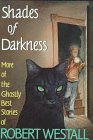
That subtitle, "ghostly," is an apt one, for several of the included tales are not ghost stories in the obvious sense, and some aren't even supernatural. What links them is Westall's gift for writing about regret, memory, and the weight of the past. Many of these stories were originally published in books aimed at young adult audiences, but Westall never talks down to his audience and, like all the best young adult fiction, his stories can be enjoyed by a reader of any age.
What I like most about the stories in these two volumes is their range, both of subjects and of sympathy. Westall can write a fine traditional ghost story about the mysterious residents of a small village and the old church that holds their secret ("St. Austin Friars"), but he can also write with authority about a ghostly soldier who links the first and second World Wars ("The Haunting of Chas McGill"), about a haunted toilet in a disused school ("The Boys' Toilets"), or about a gang of young bikers on a midnight ride ("The Night Out."). More than that, he is able to write respectfully and kindly about all these characters. Bikers aren't young toughs who deserve to punished, a cruel, controlling wife can be victim as well as villain, and the man who took an ancient photograph of a dead girl may not be the monster you expect. It seems to me that too many writers use the ghost and horror story didactically, to complain about this or that group of people, or about the horribleness of "modern times" or "city folk" or what have you. Westall can sometimes drift in that direction, but his sense of our common humanity is too strong for him to give in fully to that sort of bitter grumpiness.
But enough about humanity-- these are ghost stories, after all. Are they scary? Well, yes, I think that many of them are. "Woman and Home" manages to turn a walk through a perfectly ordinary empty house into something remarkably tense, and "A Walk on the Wild Side" reminds us just how scary even a domestic cat can be. There are, however, other kinds of atmosphere at which the ghost story can aim than fear, and Westall explores several of them. Sometimes he writes about friendly ghosts. Ordinarily I agree with M. R. James' remark that "amiable and helpful apparitions are all very well in fairy stories or local legends, but I have no use for them in a fictitious ghost story," but the one in Westall's "The Cat, Spartan" is unobtrusive enough, and the human characters so well if broadly drawn, that it works out anyway. And the kindly spirits of "Graveyard Shift" are balanced by one who is very malevolent indeed, so that's all right.
Then there are a couple stories with religious themes. As a rule I'm not big on those either, but Westall isn't preaching anything other than a very general morality, and is willing to accept characters in spite of their frailties. In "Rachel and the Angel," a young girl's thoughtless wish brings a destructive spirit to her town, and the only way she can save it is to find righteous people. This modern-day Sodom and Gomorrah plays out along familiar enough lines, but Westall knows how to make an angel frightening, and has a keen eye for the pathetic yet sympathetic sins of ordinary people. "A Nose Against the Glass" finds an old man in his antique shop on Christmas Eve, from which the apparition of a child leads him out into the snow in search of something that may be redemption. Now, if you described that plot to me, I'd be making sarcastic gagging noises and vowing never to read such a thing. The reason I finished it and liked it is that Westall makes the antique dealer feel real. He's not a Scrooge; he's a tired old man who can be happy or sad or cruel or kind depending on how his day goes, and Westall presents him in all his modes before leading him into strange events. And the ending, which reverses the expected cliche somewhat, generates a melancholy atmosphere that makes the story infinitely more memorable.
Reversals of expectation are another of Westall's virtues. One of the stories in Shades of Darkness makes you imagine evil that isn't really there, while another suggests a stock ghost story ending only to reject it in a way that sent a genuine shiver down my spine; a third mixes the ghost story with another genre to generate an unexpected conclusion. And "The Last Day of Miss Dorinda Molyneaux," which was included in Demons and Shadows and which I liked a bit more this time around, has a nice little trick up its sleeve too. A few stories feel too traditional-- "The Death of Wizards" offers the well-worn notion that being able to read others' thoughts wouldn't be much of a blessing-- but even in those cases, you can find small touches to enjoy.
Westall is also a master of what you might call the non-supernatural ghost story. What is that, you ask (assuming you didn't give up two long paragraphs ago)? Why, it's a story that achieves the atmosphere and literary "heft" of a ghost story without having anything definitely unnatural. Glen Hirshberg's The Snowman's Children is a fine novel-length example; Oliver Onions' "The Honey in the Wall" is a shorter one. Westall here offers several. I've already mentioned "The Night Out," but there's also "The Making of Me" and "Gifts from the Sea," two haunting stories about what war, or a relative's memories of war, can do to young children. And then there's "Fifty-Fafty," in which a folk tale about a tragic, ironic murder is the hinge for a meditation on injustice, history, and collective imagination. The opening to that story is such a fine example of Westall's way with words that I'm going to include two pages of it:
Friday afternoons, my mother picked me up from school and we went shopping down the town. Out of our leafy suburb, down into the smoky jungle. Wondrous shops were there, full of dinky toys and pink ladies' corsets. But the poor were there too. Beyond the shops, all down to the river, they got poorer and poorer. In the lower depths they Drank, and had no drains; emptied their soapy washing-up water and worse straight into the furrows of yellow clay paths that trickled, in the end, into the black waters of the Tyne, iridescent with the sick beauty of oil and awash with broken fish boxes, where only the inedible blackjack swam, caught by boys who had no boots or shoes, and left lying to rot on the cobbled quays. Where dirty women hung out of windows and shouted incomprehensible things as you passed, and did incomprehensible things with sailors, then cut their throats as they slept and lifted their wallets and dropped their bodies straight into the river through trapdoors in their houses.
I don't remember how old I was. I know I had sadly abandoned hope of dragons. I had checked for wolves under the stairs and found only a sack of musty potatoes, and a meter with the faint exciting whiff of gas. But there were still monsters. The lamplighter walking in front of us was a minor wizard. He put up his long pole to the gas lamps and created darkness. It was broad daylight till the gas lamps flared instantly, night gathering around them like smoke. My own headmaster was a fabulous monster of sorts. Tiny, bent, wizened and silver-haired, we loved him. But the boys said that he had once been a six-foot sergeant major in the Welsh Guards, broad as a house with a voice like a bull. Till the gas got him, in the Battle of the Somme. And down the town there were much more satisfying monsters like Happy Ralph, who lurked at the bottom of Borough Road and rushed out at you with outstretched arms and incoherent cries, whether to embrace you or strangle you nobody ever lingered to find out. On Sundays, Happy Ralph went from church to church, roaming the aisles and terrifying the vicar in his pulpit and the spinsters in their pews.
A trackless safari into the dusk. But not without waterholes. First my Aunt Rose's house, only a little way into the jungle, where people still holystoned their doorsteps and polished their knockers daily. But Aunt Rose was definitely a denizen of the jungle, her living room long and dark as a dungeon, only a pale ghost of daylight trickling in past aspidistra and lace curtain, over the massive overstuffed three-piece suite crowded like cattle in a byre.
She gave us tea, which we balanced on our knees. She stayed on her feet, solid as a bullock in her flowered pinafore, hair in a tight black bun, and railed against God.
Like many YA writers, Westall is good with direct, accessible language that nonetheless offers a tinge of the poetic. And-- I have to say it again-- he's very good with human foibles. "The Red House Clock" offers a rough, illiterate father and his more intellectually inclined son, but their strained relationship avoids stereotype; "In Camera" features a strong-minded young policewoman, but she's not Tough-As-Nails, and Westall shows that she's as aware as anyone of her own short temper. His characters are clear enough that younger readers can grasp them, but subtle enough that adults won't be bored.
So, strong prose, strong characters, and a deft hand with the ghostly in all its forms. What's not to like? As far as I can see, hardly anything. If you enjoy YA fiction or ghost stories, do yourself a favor and add Robert Westall to your reading list.
Subscribe to:
Posts (Atom)